
Share this
by Nicolas Rollet on Apr 14, 2026, 8:43:48 AM
A new scientific article has been published in Carbohydrate Polymers as part of the European BUCCAL-PEP consortium, of which AdhexPharma is a partner. This study, led by Sandeep Karki from University College Dublin in collaboration with several consortium partners, including AdhexPharma and Dr Nicolas Rollet, presents the development of a pullulan-based bilayer film for the buccal delivery of a GLP-1 peptide analogue. This approach uses epithelial permeation enhancers to improve peptide absorption.
Read the article: https://doi.org/10.1016/j.carbpol.2026.125064
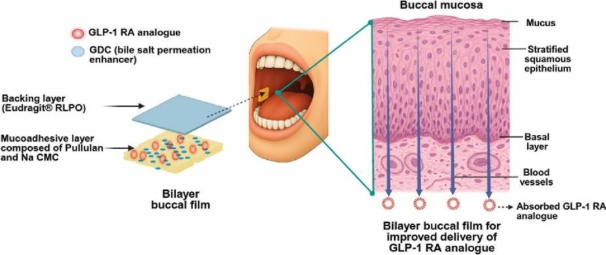 Figure 1 : Design of an oral bilayer buccal film (OBF) [1]
A major step forward in buccal peptide delivery
Therapeutic peptides offer significant clinical potential, but their administration is still often limited by the need for injection or by the challenges associated with conventional oral dosage forms. The buccal route represents a promising alternative, as it can partially bypass gastrointestinal degradation and first-pass hepatic metabolism.
In this study, researchers developed a bilayer buccal film designed to improve the local delivery and permeation of a GLP-1 analogue across the buccal mucosa.
Why choose buccal delivery? [2], [3]
The buccal route can help overcome gastrointestinal degradation and first-pass metabolism, offering several advantages:
- Painless, non-invasive administration
- No complex fasting or water intake requirements (unlike oral semaglutide)
- Rapid mucosal absorption
- Reduced dosing variability
However, peptides generally show very low permeability across the buccal epithelium, which makes the development of new formulation technologies essential. [4] [5]
The innovation behind the bilayer film [6], [7]
The researchers developed a bilayer film made of two complementary layers:
1. Mucoadhesive Layer (facing the cheek mucosa)
- Polymers tested: Pullulan, HPMC, PVA
- Selected combination: Pullulan + Sodium Carboxymethyl cellulose (NaCMC)
- GLP-1 RA peptide
- Sodium glycodeoxycholate (GDC), a bile salt permeation enhancer
2. Backing Layer (saliva repellent)
- Made with Eudragit® RLPO
- Directs drug release toward the epithelium, preventing loss via saliva
Encouraging ex vivo results [8]
- Pullulan-based film outperformed all others
- Best mucoadhesion, mechanical strength, and surface morphology
- Fastest disintegration of the mucoadhesive layer
- Highest and most consistent drug release profile
- Optimal peptide–enhancer ratio identified
Using ex vivo porcine tissue:
-
- A 1:2 ratio (GLP-1 RA:GDC) produced the highest peptide permeation (~6% at 3 h).
- Effective ex vivo permeation from films
- Single-layer films (no backing): ~4.5% flux at 3 h
- Bi-layer films (clinical candidate): ~2% flux at 3 h
- Backing layer reduces immediate release but enhances controlled, unidirectional absorption.
- Minimal tissue damage
- The bi-layer architecture moderated GDC exposure
- Histology showed preserved epithelial integrity
- Confocal imaging confirmed controlled penetration
- Chemical and structural stability
- Both peptide and GDC remained stable for at least 1 month at 4°C
- Circular dichroism confirmed preserved αhelical peptide structure
An important milestone for non-invasive peptide therapies [9], [10]
This study represents the first demonstration of co-formulating a GLP-1 analogue and sodium glycodeoxycholate in a pullulan-based bilayer film capable of improving buccal permeation.
This technology could help advance therapeutic approaches in:
- Type 2 diabetes
- Obesity
- Other peptide-treated conditions
It may also help address adherence challenges associated with injectable therapies and the strict administration requirements of oral semaglutide.
Conclusion
This pullulan-based bilayer film platform represents a promising and patient-friendly approach for the controlled buccal delivery of non-injectable therapeutic peptides. Thanks to its robust mechanical properties, excellent mucoadhesion, and significant improvement in peptide permeation, it could pave the way for a new generation of peptide therapies.
References
[1] S. Karki et al., « A pullulan-based bilayer film for buccal delivery of a GLP-1 peptide analogue », Carbohydr. Polym., vol. 380, p. 125064, mai 2026, doi: 10.1016/j.carbpol.2026.125064.
[2] B. J. Teubl, M. Absenger, E. Fröhlich, G. Leitinger, A. Zimmer, et E. Roblegg, « The oral cavity as a biological barrier system: Design of an advanced buccal in vitro permeability model », Eur. J. Pharm. Biopharm., vol. 84, no 2, p. 386‑393, juin 2013, doi: 10.1016/j.ejpb.2012.10.021.
[3] B. J. Teubl, M. Absenger, E. Fröhlich, G. Leitinger, A. Zimmer, et E. Roblegg, « The oral cavity as a biological barrier system: Design of an advanced buccal in vitro permeability model », Eur. J. Pharm. Biopharm., vol. 84, no 2, p. 386‑393, juin 2013, doi: 10.1016/j.ejpb.2012.10.021.
[4] F. Veuillez, Y. N. Kalia, Y. Jacques, J. Deshusses, et P. Buri, « Factors and strategies for improving buccal absorption of peptides », Eur. J. Pharm. Biopharm., vol. 51, no 2, p. 93‑109, mars 2001, doi: 10.1016/S0939-6411(00)00144-2.
[5] S. Malhotra, T. Lijnse, E. O. Cearbhaill, et D. J. Brayden, « Devices to overcome the buccal mucosal barrier to administer therapeutic peptides », Adv. Drug Deliv. Rev., vol. 220, p. 115572, mai 2025, doi: 10.1016/j.addr.2025.115572.
[6] S. Karki, H. Kim, S.-J. Na, D. Shin, K. Jo, et J. Lee, « Thin films as an emerging platform for drug delivery », Asian J. Pharm. Sci., vol. 11, no 5, p. 559‑574, oct. 2016, doi: 10.1016/j.ajps.2016.05.004.
[7] D. J. Brayden et V. Stuettgen, « Sodium glycodeoxycholate and sodium deoxycholate as epithelial permeation enhancers: in vitro and ex vivo intestinal and buccal bioassays », Eur. J. Pharm. Sci., vol. 159, p. 105737, avr. 2021, doi: 10.1016/j.ejps.2021.105737.
[8] S. Karki et al., « A pullulan-based bilayer film for buccal delivery of a GLP-1 peptide analogue », Carbohydr. Polym., vol. 380, p. 125064, mai 2026, doi: 10.1016/j.carbpol.2026.125064.
[9] Z. Zheng et al., « Glucagon-like peptide-1 receptor: mechanisms and advances in therapy », Signal Transduct. Target. Ther., vol. 9, no 1, p. 234, sept. 2024, doi: 10.1038/s41392-024-01931-z.
[10] « Glucagon‐like peptide agonists: A prospective review - Mariam - 2024 - Endocrinology, Diabetes & Metabolism - Wiley Online Library ». [En ligne]. Disponible sur: https://onlinelibrary.wiley.com/doi/10.1002/edm2.462