
Share this
by Christine Kaufmann on Sep 13, 2026, 11:00:00 AM
A patch may look simple from the outside: a thin, flexible piece of material applied to the skin. But beneath its surface, a pharmaceutical patch is a carefully engineered drug delivery system.
For an API-containing patch, every layer has a specific purpose. Together, these components determine how the patch adheres to the skin, protects the drug, controls its release, and delivers the active pharmaceutical ingredient (API) to the intended site.
For developers and formulators, understanding this architecture is essential. The way a patch is constructed is not simply a matter of material selection or manufacturing convenience. The arrangement and properties of its individual layers are fundamental to the performance of the final dosage form.
So, how exactly is an API-containing patch built?
The basic anatomy of a patch
Although patch designs can vary considerably, a typical pharmaceutical patch can contain several functional layers:
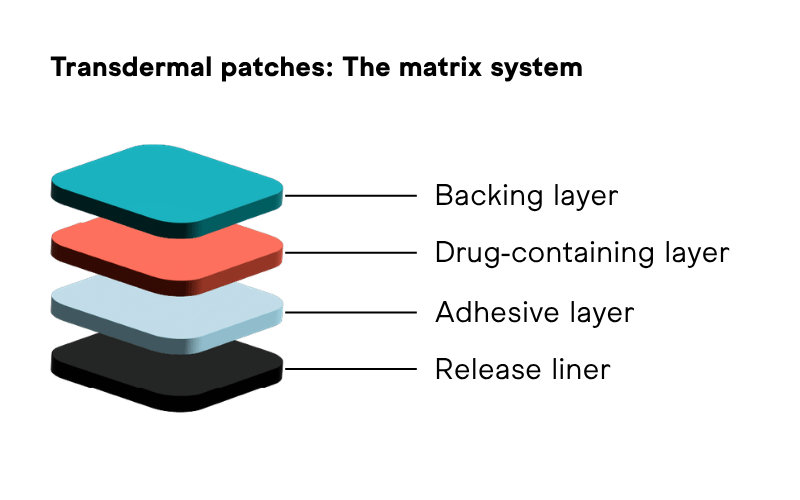
Not every patch contains all of these layers in the same configuration. Some designs combine functions, while others introduce additional components.
Let's take a closer look at the role of each layer.
1. The backing layer: protecting the system
The backing layer forms the outermost part of the patch. Its primary role is to protect the drug-containing system from the external environment.
Depending on the formulation and intended application, the backing layer can provide protection against factors such as moisture, oxygen, light, and mechanical stress. At the same time, it needs to be sufficiently flexible to allow the patch to conform to the body during use.
For formulators, the backing layer therefore needs to balance several requirements: protection, flexibility, compatibility with the underlying layers, and appropriate barrier properties.
It is also worth remembering that the backing layer is not simply a protective cover. Its properties can influence the overall performance. It can especially influence the drug release as well as the convenience of wearing the patch. In that sense it needs to be considered as part of the complete dosage-form design.
2. The drug-containing layer: where the API resides
At the heart of an API-containing patch is the layer that contains the active pharmaceutical ingredient.
This layer can take different forms depending on the patch architecture. In a matrix system, for example, the API is incorporated into a polymeric or adhesive matrix.
The drug-containing layer needs to accommodate the API while maintaining the required physical and chemical properties throughout the product's shelf life and intended use. Its composition and structure can have a direct influence on how the API becomes available at the skin interface.
In other words, the question is not simply "How much API can we put into the patch?" but rather "Where is the API located, and how is it incorporated into the patch architecture?"
3. The adhesive layer: keeping the patch where it belongs
A pharmaceutical patch needs to remain in close contact with the skin throughout its intended application period. This is where the adhesive comes in.
The adhesive layer provides the necessary skin adhesion while also forming part of the functional interface between the patch and the skin.
In some patch designs, the adhesive is a separate layer. In others, the adhesive itself also contains the API. This latter approach is commonly referred to as a drug-in-adhesive system.
This creates an important formulation challenge: the adhesive must fulfil its mechanical function while remaining compatible with the API and the other components of the system.
Adhesion, flexibility, skin compatibility, drug stability and drug release therefore cannot always be considered independently. They are interconnected aspects of the patch design.
4. The release liner: protecting the patch until use
The release liner is the protective layer that covers the skin-facing side of the patch before application.
Its job is straightforward but critical: it protects the adhesive and, depending on the design, the drug-containing surface during storage and handling. Immediately before application, the liner is removed to expose the functional surface of the patch.
Although it is removed before use, the release liner is still an important part of the overall product design. Its interaction with the adhesive and the ease with which it can be removed need to be carefully controlled.
A patch that performs perfectly in the laboratory but is difficult to open, handle or apply is not necessarily a successful dosage form.
Beyond the basic structure: different patch architectures
The layers described above provide a useful framework for understanding a pharmaceutical patch. However, there is no single architecture that fits every API or every therapeutic objective.
The location of the API within the system can vary, as can the way the different layers interact with one another.
This is where different patch technologies become particularly interesting.
Transfilm®
AdhexPharma's Transfilm® technology, being a matrix-system, can be used for topical delivery, where the objective is local treatment, or for transdermal delivery, where the API is intended to reach the systemic circulation. It is therefore providing consistent and controlled drug delivery.
.png?width=800&height=500&name=Subtitle%20(1).png)
Impregnated Matrix Patch: separating drug and adhesive functions
Another approach is the Impregnated Matrix Patch. Here, the drug-containing zone and the adhesive function are designed differently from a conventional drug-in-adhesive matrix. The API is contained within the application area and does not come into contact with the adhesive, allowing for a higher potential drug load.
The important point is that these technologies demonstrate a broader principle: the architecture of a patch can be adapted to the requirements of the API and the intended drug delivery profile.
The choice of where the API is located, how it is incorporated, and how the different layers are arranged can therefore be just as important as the choice of the individual materials themselves.
.png?width=800&height=500&name=Subtitle%20(2).png)
Designing the right architecture
For developers and formulators, the anatomy of a patch provides a useful starting point for understanding the complexity of these dosage forms.
A backing layer needs to protect the system. A drug-containing layer needs to accommodate the API. An adhesive needs to maintain reliable skin contact. A release liner needs to protect the product until application.
But these functions do not exist in isolation.
The challenge lies in bringing them together into one stable, manufacturable and user-friendly dosage form.
Ultimately, a successful patch is the result of integrated design: the API, formulation, materials, layer structure and manufacturing process all need to work together as one system.
Luckily, there are CDO’s and CDMO’s (contract development and manufacturing organizations), like AdhexPharma, who have multiple years of experience in developing these pharmaceutical products and handling all the special questions and hurdles when it comes to patches. These experts really can support in making a product idea come to reality.
About AdhexPharma
AdhexPharma is an independent pharmaceutical company specializing in the development and manufacturing of patches, oral films and other complex dosage forms. As a full-service CDMO, the company supports pharmaceutical and biotechnology partners from drug development through manufacturing, including formulation and development activities, analytical services and commercial production.
As part of the AdhexPharma group, Labtec serves as an R&D competence center in Germany, with expertise in the formulation, development and manufacturing of transdermal and topical patches as well as buccal and sublingual films.
With decades of experience in drug delivery, AdhexPharma and Labtec combine formulation expertise, patch technology and industrial manufacturing capabilities to support the development of complex pharmaceutical dosage forms — from early-stage development to commercial production.